
Popcorn Ceiling Removal in The Woodlands, Texas: Testing, Scraping and Refinishing by The Woodlands Drywall Co.
The Woodlands Drywall Co. has handled popcorn ceiling removal for homeowners and property owners across The Woodlands, Texas for 20 years, and the work starts long before we climb a ladder. The job is to remove the bumpy sprayed coating and leave you with a smooth surface ready for paint, but every ceiling takes a different path to that finish. Painted texture will not scrape off, some ceilings are better covered over than removed, and what we find underneath determines how much finishing work comes next.
One question determines everything that follows: what the texture on your ceiling is made of. If it was applied before 1990, that means asbestos testing, because some sprayed textures from that era contain asbestos and nobody can identify which ones do just by looking from the floor. Asbestos work in this state is regulated by the Texas Department of State Health Services. Once the reading comes back, we hang containment barriers to seal the room off from the rest of your house before the first blade goes up.
The scraping itself is the quick half. Wet scraping removes the texture, then a skim coat of joint compound and stain-blocking primer leave the ceiling ready for paint, whether you want a smooth finish or a current texture. Most single-home projects are completed within a 2-to-4-day project window.
Shenandoah, Oak Ridge North and Creekside Park are all within our service area, which extends across Montgomery and Harris Counties. Call (346) 248-4075 or use our quote form for a free on-site estimate.
Get A Free Quote
Why the Ceiling Is Coming Down
Almost everyone who calls us about textured ceiling removal has one of a short list of reasons, and some are more urgent than others. Some projects can wait until the budget works for you, while others come with a fixed date you cannot move. Knowing which situation you have before asking for a price matters, because it changes what the job needs to include.
A Texture That Dates the Room
Acoustic texture is the bumpy white coating that was sprayed onto ceilings for decades. Because it was sprayed rather than spread by hand, a crew could finish an entire house in a day, and the bumps hid the taped joints between the ceiling boards so those joints no longer had to be sanded perfectly flat. The texture also softened echo in a room, which is where the word acoustic in its name comes from. It was chosen for speed and sound, never for its appearance.
That is why a room with new floors, fresh paint and new fixtures can still look older than it is when the ceiling remains textured, and why so many Grogan's Mill-era homes here reach us with everything updated except the ceilings.
Dust, Cobwebs and a Surface You Cannot Clean
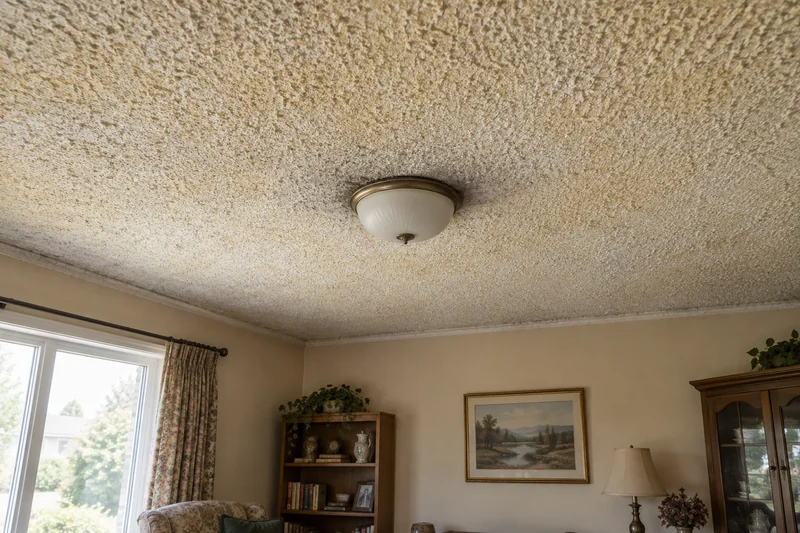
The same ridges that absorb sound also trap household dust, and a textured ceiling gives that dust far more surface area to settle on than a flat one. You cannot simply wipe it clean, because a damp cloth softens the coating and pulls it off with the dirt, leaving a bare patch that looks worse than the grime. Vacuuming with a soft brush head is the only safe method, and even then it reaches the tips of the bumps rather than the hollows between them. Smooth ceiling refinishing ends that problem, because a flat, primed ceiling sheds dust instead of holding it, takes a duster without damage, and can be washed once it has been painted.
Selling, Refinancing or Remodeling
This is the reason that comes with a date attached. The ceiling is the largest single surface in most rooms, and buyers read a textured one as a sign of an older interior before they notice anything else. It shows in listing photographs too, where side lighting catches every bump and leaves the ceiling mottled with shadow. Popcorn ceiling removal is one of the few changes that improves both the photographs and the walkthrough. It also belongs early in a remodel, because smooth ceiling refinishing comes before new flooring, new lighting and fresh paint, so a project that stops at the walls does not leave the oldest surface in the room untouched.
A Patch That Will Never Match
Once a textured ceiling has been opened for a roof leak, a new light or ductwork running through the attic, the repaired area remains visible. Ceiling repair itself is separate work, but the finish over that repair is the challenge here. Sprayed texture is matched by eye and spray pattern rather than to a specification, and because ceiling light rakes across the surface from every seat in the room, any difference in bump size shows up more clearly than it would on a wall.
Texture matching is a real skill, but it has limits. Trying to match one repaired area across a textured ceiling often costs more than removing the ceiling texture throughout the room, and popcorn ceiling removal leaves you with one continuous surface where no repair is hiding.
Free Quote FormWhat a Popcorn Ceiling Removal Job Includes
Popcorn ceiling removal follows a standard process, with the same steps completed in the same order on almost every house we work in. What changes is anything a particular ceiling needs beyond that standard work, and each additional item appears on your quote as a separate line with its own price before the job begins, not after it is finished. That makes it easy to place our quote beside another one and see exactly where the two differ.
Whole House, or One Room at a Time
Where a scraped ceiling meets a textured one at a doorway, the change is visible from both rooms. That edge cannot be feathered or blended away because the two surfaces sit at different depths and the opening places them side by side in the same line of sight. The line is a choice you make, not a defect left behind, which leads to one practical rule: rooms that see each other should be done together. In an open plan, the living, dining and kitchen ceilings are one job for that reason. Bedrooms are separated by doors, so they can wait for a later visit without the join ever showing.
What Is in the Price and What Is a Separate Line
Smooth ceiling refinishing includes four things as standard: protecting and closing off the room, scraping away the texture, applying and sanding the skim coat to bring the surface flat, and covering the finished board with stain-blocking primer. Four other items are quoted separately because not every ceiling needs them. The lab test is one, repairs uncovered during scraping are another, and a new texture is a third if you prefer that over a smooth finish. Finish paint is the fourth. Priming and painting are separate operations here, so primer is included as standard, while the color coat over it is optional and priced on its own line.
Free Quote Form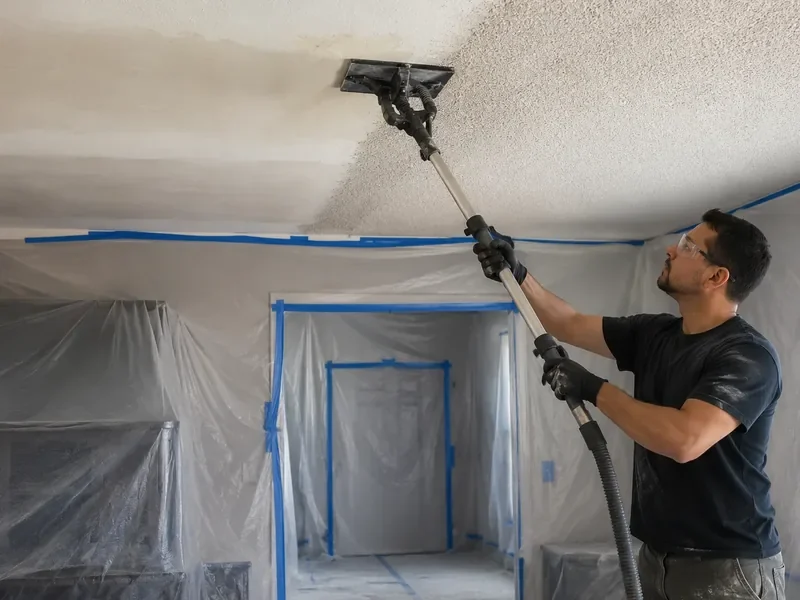
The Ceilings We Will Not Scrape
Three conditions stop the work. A sample that comes back positive ends the scraping outright, because that material is not ours to remove. A ceiling that is wet, or stained from a source nobody has traced yet, is not ready to be refinished because putting a new surface over uncorrected moisture only leads to another failure. A ceiling that has dropped beyond the slight sag drywall develops over the years points to a problem with the structure holding it up, not the finish on it. Asbestos testing and a close look at the ceiling during the estimate find all three while they cost you nothing; discovered on the second morning of the job, they cost a week.
Testing the Ceiling First, Then Scraping
Popcorn ceiling removal starts with a question that has nothing to do with the removal method: what is actually in the coating. That answer comes from a laboratory, and we need it before a blade ever touches the ceiling. Sprayed acoustic texture was blown on wet and left to harden, and once it has been broken open, it cannot be put back. Scraping first and getting a positive result afterward leaves you with an opened ceiling and a much bigger job than the one you originally asked for.
Only then does the removal method come into play, and there is more than one way to handle it.
The Asbestos Test, and What a Positive Result Means
Our rule is simple: no ceiling installed before 1990 is touched until it has been tested. That cutoff is deliberately later than necessary, because the cost of testing a ceiling that comes back clear is small, while the cost of guessing wrong is not.
The test uses a bulk sample, a small piece of the texture cut away and sent to a laboratory. There it is examined with polarized light microscopy, which distinguishes one type of fiber from another. Nothing you or we can see from the floor answers the question, because texture that contains asbestos looks identical on the ceiling to texture that does not. Age is what puts a ceiling on the testing list; the sample is what gives the answer.
Most samples come back negative, and the job then proceeds exactly as quoted. If the test comes back positive, a licensed abatement contractor handles that material before we return. The Texas Department of State Health Services regulates asbestos work in this state, and we do not hold a license under it. The licensed contractor will explain what happens next, what your options are and what each one costs. Once their work is finished, we pick the job back up.
Wet Scraping, and Where Water Stops Working
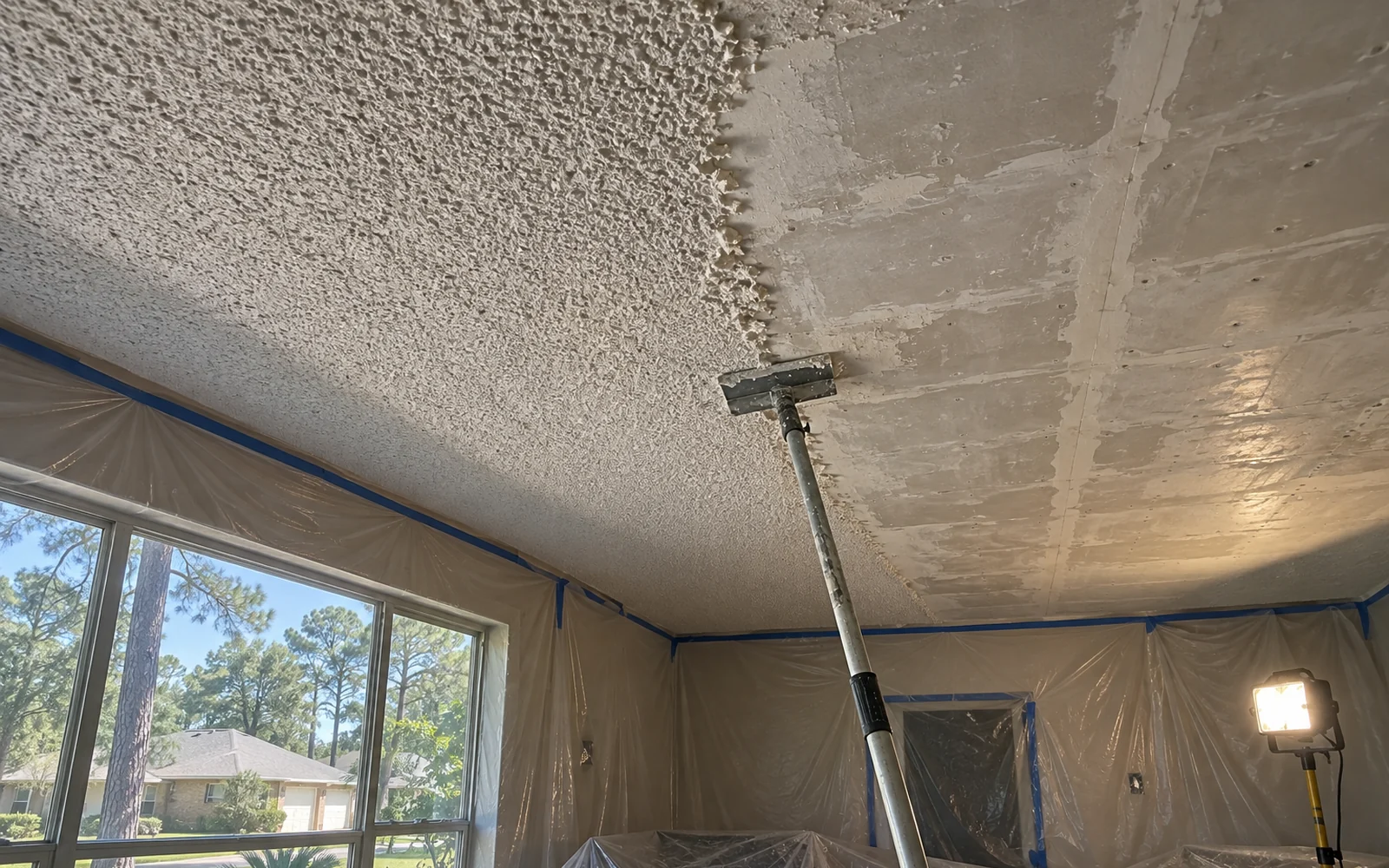
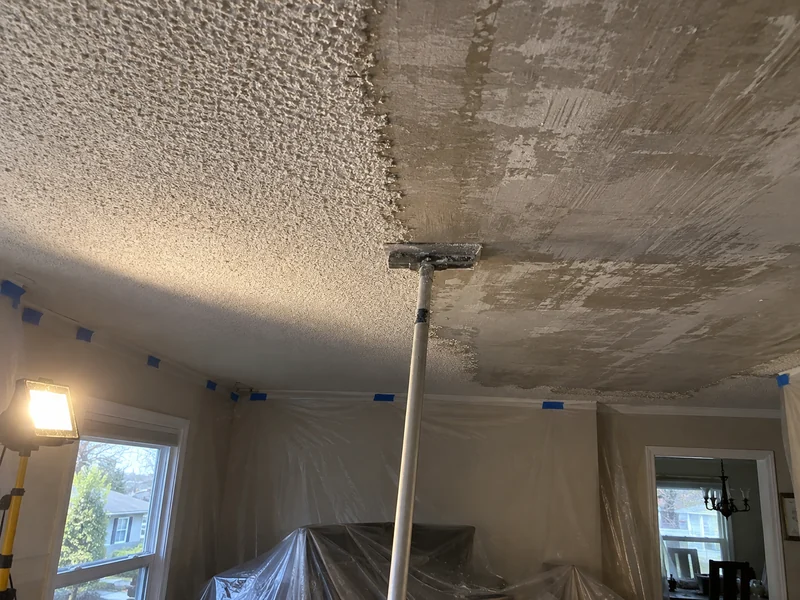
A wet scrape means exactly what it sounds like: we lay a fine mist over the texture and give it a few minutes to soak in, softening the material so it releases in damp sheets instead of breaking into airborne dust. A wide blade then lifts it away at a shallow angle, sliding under the texture without digging into the ceiling. Force is not what gets the ceiling clean; the angle of the blade does.
Water is also where ceiling texture removal reaches its limit. Beneath the texture is a paper face bonded to the board, and too much water makes that paper swell. Once swollen, the face tears under the blade, and the job stops being a simple scrape and becomes a repair skimmed over damaged paper. The right amount of mist, and how long it can sit before the paper begins absorbing it, is judged room by room and often wall to wall. Where a ceiling cannot take water at all, popcorn ceiling scraping continues dry, which creates far more dust and serves as the fallback rather than our preferred method.
When the Texture Has Been Painted Over
Paint seals acoustic texture by closing the surface so water cannot reach and soften the material underneath, which means painted popcorn stays hard no matter how long the mist sits on it. It then breaks away in hard chunks, and those chunks pull the face paper down with them. What could have been quoted as a scrape becomes either a full skim coat across the entire ceiling or a cover-over.
We find this while preparing the quote, not after the crew is already on a ladder, by wetting a small test patch in one corner and watching whether the texture softens. Paint is not something you can reliably identify from the floor, because a thin coat rolled on years ago can look like bare texture from ten feet below. Found during the estimate, it becomes a revised price you can decide on. Found after the work has started, it leaves you with a stalled ceiling and a conversation nobody wanted.
Covering Over Instead of Scraping
Ceiling texture removal is not the only way to get a flat ceiling. New board can be installed over the existing ceiling, sealing the old texture behind it. How thin that board can be depends on what is already there and how far apart the joists are, so we determine that during the estimate rather than assume it. The trade calls this enclosure: the material stays in place, closed behind new board, instead of being removed. Hanging that board is ceiling installation work and comes with its own requirements.
Two things determine whether this is the better choice for you. The first is height, because every added layer lowers the ceiling, and a room that already feels low will feel lower. The second is whether the existing ceiling is sound enough to carry another layer, which we determine during the estimate. A covered ceiling is not finished when the board goes up, either. The joints still need to be taped, skimmed level and primed across the entire surface before it looks like a finished ceiling rather than a set of panels.
What Popcorn Ceiling Removal Leaves Behind
Scraping the texture off is the fastest part of the day, and it is also the smallest part of the job. What the scrape reveals is a surface that has never been finished, and bringing that surface up to a ceiling worth looking at is where most of the hours in a popcorn ceiling removal job are spent. The condition underneath determines both how long we are in your house and how the ceiling looks when we leave.
A Ceiling That Was Never Finished to Be Seen
Sprayed texture was a finish in its own right, which meant the builder could stop short on the ceiling beneath it. The seams between the boards were covered with paper tape and filler, but those tape joints were filled only enough to hold, while the screws fastening the gypsum board, the trade's name for drywall, to the joists overhead were sunk without being smoothed over. None of it was meant to be seen. Once ceiling texture removal takes the coating away, those joints and fastener heads become the surface you see across the entire ceiling.
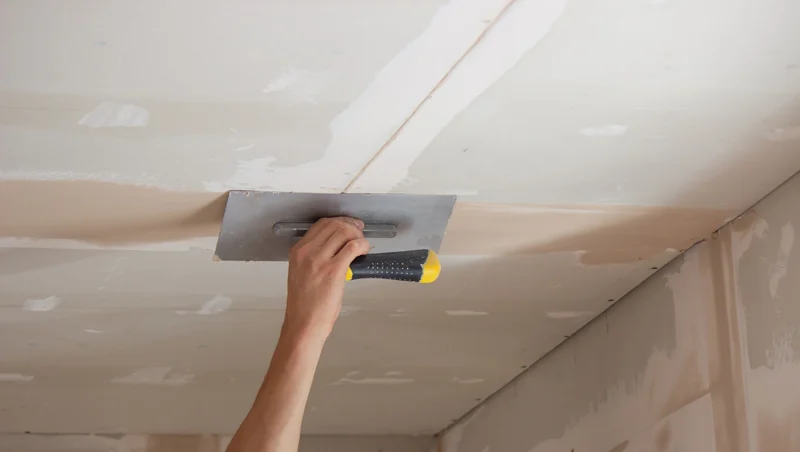
Two other problems commonly show up on a ceiling of this age. Screws loosen over time and push small bumps through the finish, while the board relaxes slightly between the joists that support it, spaced a foot and a half to two feet apart, leaving a shallow dip that becomes visible once the ceiling is flat. We identify both during the estimate and price them on separate lines, because each one is repair work rather than part of the scrape. A quote that covers scraping alone has not priced the ceiling you will actually end up with.
Skimming to a Flat Plane
A skim coat is a thin layer of joint compound, the plaster-like filler the trade calls mud, spread across the entire ceiling instead of just over the seams, and it is what turns a scraped surface into one flat plane. Compound shrinks as it dries, so a single pass settles slightly where it is thickest. Popcorn ceiling resurfacing therefore takes two or three coats of compound, with sanding between them, and each pass fills what the previous one left behind.
Flatness is judged from the end of the room rather than directly underneath, because a ceiling is seen along its length and light traveling across it exposes every ridge and hollow. Sanding, not scraping, creates the fine dust, so the containment stays in place until the final coat is flat. How smooth the surface is taken, and whether a new texture goes on instead, are part of our finishing and texture work.
Stain-Blocking Primer, and Why It Comes Before Paint
A freshly skimmed ceiling absorbs paint unevenly because bare compound is porous while the older surface beside it is not. Old texture also holds stains from roof and plumbing leaks, smoke and years of cooking, and ordinary wall primer does not stop them from bleeding through. The mark works its way back through the paint film and reappears, sometimes weeks after the finish coat has dried. Stain-blocking primer is made to seal a stain in place rather than simply cover it, and one coat goes across the entire ceiling so smooth ceiling refinishing ends with uniform porosity. Finish paint is quoted on its own line.
Free Quote FormCeiling Stains, Sag and What Has to Be Fixed First
A stain or dip in a ceiling points to something happening above the finish, and a new surface does not fix what is going on up there. If the source above it has not been corrected, the refinished ceiling fails again in the same place.
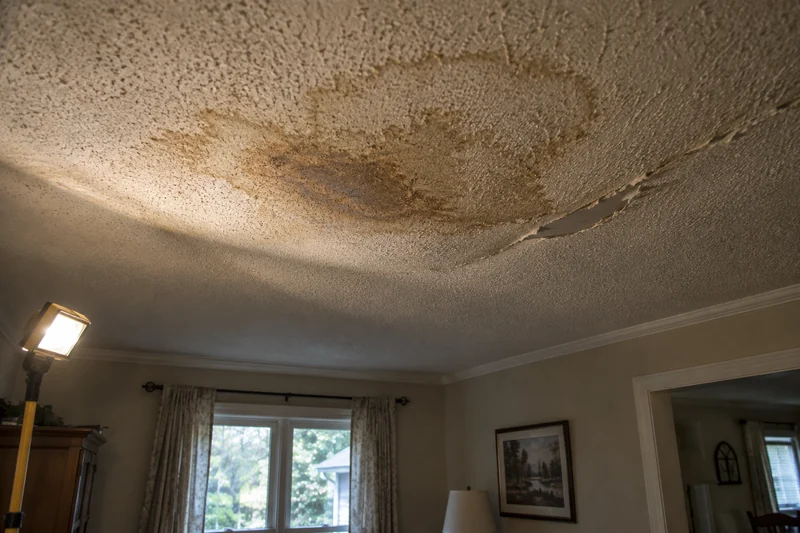
So we look at both during the estimate, before setting a date with you. Covering either one only hides the evidence instead of answering the question it raises.
A Brown Mark Is a Question, Not a Blemish
A brown or yellow mark means water reached the ceiling at some point. Whether water is still reaching it is a separate question, and a moisture meter gives us the answer by reading how much water is held in the material, so we take moisture readings before anything is closed up. The source is usually the roof, a supply line, or the condensate line that carries water away from the air conditioning. None of those is ours to repair, while drying out a wet cavity and rebuilding it is separate work we handle as water damage repair. If the ceiling is still wet, popcorn ceiling removal waits until the source has been repaired.
A Ceiling That Has Started to Sag
A shallow dip between the framing is a condition of the ceiling itself, not of the finish on it, and ceiling texture removal does nothing to correct it. A flat skim over a ceiling that is not flat looks worse than the texture did, because a smooth plane shows every deviation from it. Drywall that has sagged a little between the joists over the years is one thing, and on a house of this vintage it is normal. A ceiling that is still moving is another. The direction of cracking and whether it returns are clues, and we do not diagnose either from the surface. Wider, recurring, or displaced cracks can warrant evaluation by another qualified professional.
Why Choose The Woodlands Drywall Co. for Popcorn Ceiling Removal
Once the texture is gone, what remains is bare gypsum board, taped seams and fastener heads, and bringing that surface flat and paint-ready is drywall work. Popcorn ceiling removal is therefore a drywall job with a scraping step at the beginning, not a painting job with scraping added on. We are a drywall firm, and the skim coat that determines how your finished ceiling looks under light is the work we do every week.
Four things are included with that work, and none is priced as an extra or passed to someone else partway through:
- Containment barriers and vacuum-assisted sanding are included in the base scope, keeping the dust inside the room where it is created.
- The estimator who inspects your ceiling also runs the crew that scrapes it, so nothing is lost between the inspection and the work.
- You receive a written quote within 24 hours of the visit, itemized line by line.
- One insured contractor carries the job from scraping through the skim coat to the stain-blocking primer.
The Woodlands Drywall Co. has served The Woodlands, Texas, for 20 years. We are fully insured, and financing is available for qualifying work. To have your ceiling looked at and priced, call (346) 248-4075 and we will come out at no charge.
What Popcorn Removal Costs
No two ceilings are priced exactly the same, and we would rather give you no figure at all than quote a square-foot rate that does not apply to your rooms. What we can give you is the full list of factors that affect the price, so you can look at your own ceilings, get a rough sense of where they fall, and compare any quote you receive against the same list.
We inspect the ceiling in person at no charge, and you receive an itemized written quote within 24 hours of that visit.
What Makes One Ceiling Cost More Than Another
Ceiling area in square feet is the first thing anyone measures, and it is the simplest price factor because it scales predictably. Ceiling height does not. A standard room can be reached from a pole or low platform, while a vaulted living room or two-story entry requires a scaffold tower that must be built, moved and rebuilt as the crew works across the room. That access alone extends the day, regardless of how much ceiling surface is overhead.
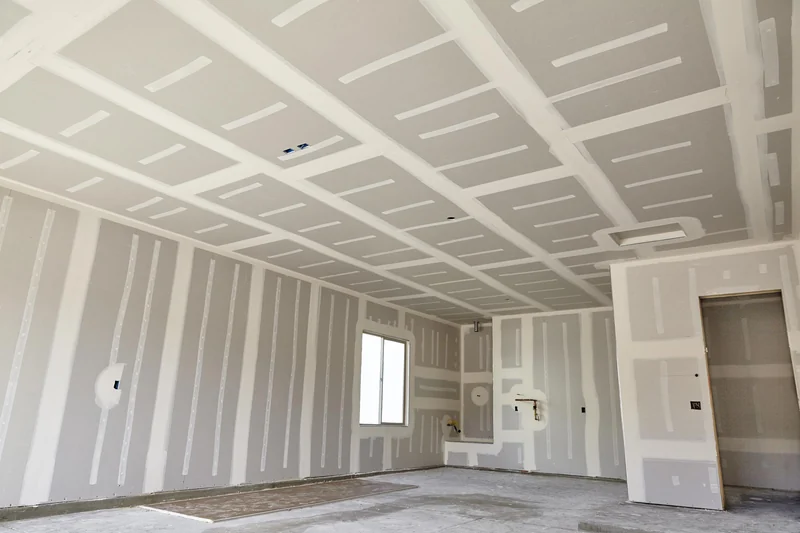
How the work is grouped matters in the same practical way. Rooms completed together share one setup of floor protection and plastic, while a room done on its own later requires that setup again. A furnished house takes longer to protect than an empty one because everything that remains in the room has to be covered and sealed before scraping begins. Can lights, ceiling fans and air registers each create an edge that must be masked by hand, so a ceiling filled with them takes longer than a plain ceiling of the same size.
The Test, the Repairs and the Finish as Separate Lines
Three things sit outside the base scope and appear as separate lines on your quote. Asbestos testing is a known, small, fixed cost because the sample goes to a laboratory and the fee does not change with the size of your ceiling. Repairs are different, because nobody knows what the texture has been hiding until it comes off, and loose tape joints or damaged board only become visible then.
We quote repairs once we can see what the ceiling actually needs instead of burying an average allowance inside a square-foot rate, because that kind of hidden allowance makes two quotes difficult to compare. The finish is also a clear choice with its own price: a new texture in place of a smooth ceiling appears on a separate line, as does finish paint, while stain-blocking primer is included in the job.
Doing It Yourself, and What It Actually Saves
What you save by doing popcorn ceiling scraping yourself is labor, because joint compound and plastic sheeting make up the smaller half of the cost either way. What you shoulder is the testing decision, containment, cleanup and skim coat. The skim coat is what determines whether the ceiling looks finished under a lamp, and it takes longer to learn than scraping. Water and electricity overhead are the part people underestimate, so fixtures come down or are sealed before anything is wetted. A small, unpainted ceiling in an empty room is a genuine weekend job for a careful homeowner.
If you can tell us which rooms are involved, how high the ceilings are and what is still in each room, call (346) 248-4075 and we will price your ceiling texture removal using those same factors.
Popcorn Ceiling Containment, Removal and Refinishing
Popcorn ceiling removal takes place in a house that is still being lived in, and the order of the work is what keeps the rest of the house usable while one room is out of service. The Woodlands Drywall Co. follows the same five steps on every job, so you know in advance which day will be the loud one and when the room will be ready for you again.
-
The visit and the written quote
Someone comes out to inspect the ceiling before we give you a price, because four things can only be settled in the room: how old the ceiling is, whether the texture has been painted, what condition the surface is in, and how the room can be reached with sheeting and ladders. The visit costs you nothing, and the itemized quote reaches you within a day. You can send photographs ahead of time and we will give you a range from them, but the final price waits for the visit.
-
The sample, if the ceiling is old enough
On a ceiling installed before 1990, we cut a sample from the ceiling and send it to a laboratory for testing. Asbestos testing determines when the work can start, because we confirm the work date only after the result is in hand.
-
Closing the room off
Furniture is removed from the room, and anything that cannot be moved is wrapped in place. Floors and walls are covered with plastic sheeting, doorways are sealed, and supply and return vents are covered so your air conditioning does not pull dust out of the room and carry it through the rest of the house. The barriers stay up until the end of the job, not just until the scraping is finished.
-
The scrape and the skim
Popcorn ceiling scraping removes the texture in a day, and the bare board underneath is then inspected to see what it needs. We build the surface back up with a skim coat applied in passes and sanded between each one. A 2-to-4-day project window covers most single-family houses. If the ceiling needs repairs, we bring them to you for approval before carrying them out.
-
Primer, clean-up and the walk-through
One coat of stain-blocking primer goes across the entire ceiling, the containment comes down, and the room is cleaned. We then inspect the ceiling with you in the room's own daylight before closing out the job. Finish paint, if you chose it, appears as a separate line and is completed on a separate visit.
To schedule the visit that starts your ceiling texture removal, call us at (346) 248-4075 or send the details through the quote form.
Popcorn Ceilings in The Woodlands' Older Villages
Two conditions specific to this area change how a ceiling job runs. The first is the year your house was built, which determines whether a sample of the acoustic texture goes to a laboratory before we touch it. The second is the weather outside while we work, because the compound spread across your ceiling has to dry before the next coat can go on. Popcorn ceiling removal in The Woodlands is planned around both.

What Was Going Up When the Villages Were New
Sprayed acoustic texture was not a style choice when the first villages went up in the 1970s. It was the standard ceiling finish, so 1970s Grogan's Mill-era houses carry it almost as a rule, and it remained common through the 1980s. That timing is why we ask when your house was built before quoting acoustic ceiling removal: ceilings installed before 1990 fall under our testing rule, and the sample determines the job. A later house can still have the same texture overhead, because builders kept spraying it long after the first villages were finished.
Humidity, the Air Conditioning and How Long the Coats Take
Ordinary joint compound hardens by releasing its water into the air, so damp air slows the process. In our humid subtropical climate, humidity stretches a job more than summer highs around 94 degrees, and a closed-up house with the air conditioning off is the worst case. Compound that has not finished shrinking will crack once another coat is applied over it, which is why your house stays cooled and running throughout the work. When the schedule is tight, we use setting-type compound for the skim coat instead, which hardens through a chemical reaction rather than by drying out.
Free Quote FormPermits, Disposal and the Rules Around Ceiling Texture Removal
Two separate questions usually get asked as one. People ask whether they need a permit, when what they really want to know is what has to happen before we put a blade to the ceiling. A permit and our own rule are two different things, and our rule applies to every job we do. Asbestos abatement is licensed work in this state and falls outside the work we do.
The Permit Question, and the Rule That Does Bind Us
Taking texture off a ceiling and refinishing the surface does not change the structure of your house, and popcorn ceiling removal is not work that normally requires a building permit. Requirements are set by the authority for your specific address, so if you want certainty, ask them directly rather than rely on our word alone.
What always applies before any scraping begins is our own rule about testing. We take a bulk sample from every ceiling area installed before 1990 and have it tested at a laboratory, and we do not start work until that result is in hand, regardless of the local permit schedule. A rental, lease unit or commercial space is a separate conversation, but it begins with the same sample.
Where the Material Goes
Scrapings from a ceiling that tested clear are ordinary construction debris. Because the texture is wetted before scraping, it comes down heavy and stays where it falls instead of drifting through the room as loose dust, making the debris easy to collect. It lands on the plastic sheeting and is bagged as the work moves along rather than swept up at the end.
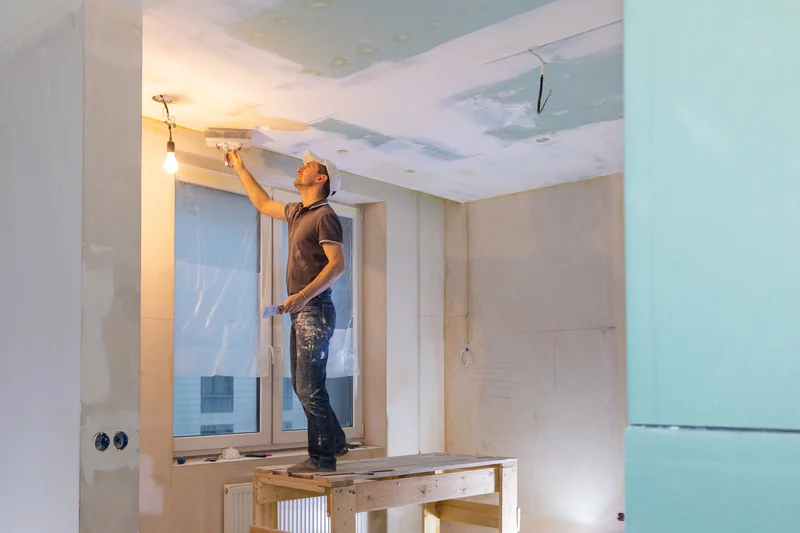
When a section of sheeting is full, we fold it in on itself so the wet material stays contained inside the plastic and never touches your floors on the way out. The bags leave through the same door the crew entered, instead of being left sitting in your driveway. Material from a ceiling that did not test clear is not ours to handle, and no part of that ceiling texture removal moves forward.

Where We Take Popcorn Ceilings Down
Sprayed acoustic texture went up on ceiling after ceiling throughout the decades when these neighborhoods were built, and the housing stock across The Woodlands, Texas and the surrounding communities spans those same years. That is why popcorn ceiling removal is steady work here rather than an occasional call. If your house is one of the older ones, the ceiling overhead is likely the original finish. In practice, we work in these houses often enough to know what is above most of their ceilings before we ever walk through the door.
The Woodlands Drywall Co. serves twenty-one communities across Montgomery County and Harris County.
Communities The Woodlands Drywall Co. Serves
Villages of The Woodlands:
- Alden Bridge
- Cochran’s Crossing
- College Park
- Creekside Park
- Grogan’s Mill
- Indian Springs
- Panther Creek
- Sterling Ridge
And the surrounding communities:
- Conroe
- Atascocita
- Spring
- Porter
- New Caney
- Humble
- Kingwood
- Tomball
- Willis
- Pinehurst
- Shenandoah
- Oak Ridge North
- Magnolia
Popcorn Ceiling Removal Questions
What is the easiest way to get rid of popcorn ceiling?
Mist the texture, give the water a few minutes to soften it, then lift it away with a wide blade. That is the quick half of the job; the smoothing that follows is what determines how the finished ceiling looks. This method only works on bare texture, though, because paint sheds the water the scrape depends on, so a painted ceiling requires a different approach.
How much does it cost to remove a popcorn ceiling from a 1500 sq ft house?
We do not put a price on this page, because the only one that matters is the price for your ceiling, and we have not seen it yet. One thing to know before comparing quotes is that your house's floor area is not the same as the ceiling area in the scope, because closets, stairwells and any rooms you are leaving alone are excluded. Someone walks the rooms with you at no charge.
Is it cheaper to remove popcorn from the ceiling yourself?
Yes, on labor, because materials are the cheaper half either way. The catch is the part nobody can price in advance: once the blade cuts into the paper face of the board, the job stops being a finish and becomes a repair. One bare ceiling in a cleared room is a reasonable weekend project. A furnished house with vaulted rooms is not.
How long does it take to get rid of a popcorn ceiling?
A 2-to-4-day window covers most jobs. Three things extend it: every pass of compound must harden fully before the next one goes on, and humid weather slows that process; repairs uncovered during scraping add their own day; and staging rooms one at a time so you can remain in the house spreads the work across a longer schedule. None of those days are scheduled until the laboratory result on the sample is back in our hands.
Will removing popcorn ceiling increase home value?
Nobody can give you a reliable percentage for that without seeing your house, and anyone who does is guessing. What a smooth ceiling changes is how the house presents, both to someone standing in the room and in photographs, where the largest surface no longer makes the interior look older. What that change is worth on your particular house cannot be known in advance.
What does popcorn ceiling removal include?
Everything needed to hand you back a paint-ready ceiling is included: sealing the room, the lab sample when the ceiling's age calls for one, removing the texture, bringing the surface flat, and priming it. Three more items appear on their own lines because they vary from house to house: repairs uncovered beneath the coating, retexturing where you do not want a flat finish, and the paint. Light fixtures and ceiling fans that need to come down are listed on the quote as well, so neither of us is left making assumptions.
Is popcorn ceiling removal messy?
Yes. Sheeting covers the floors and walls, doorways are sealed, and vents are covered so dust does not travel through the air conditioning. Those barriers stay in place through the sanding instead of coming down after the scrape, because sanding, not scraping, is what puts the fine dust into the air.
Do I need a permit to remove popcorn ceilings?
Usually not, because refinishing a surface does not change anything structural. We do not treat that as an absolute, though, because every address falls under its own local authority. What does determine our start date is our own rule: on a ceiling built before 1990, a sample from each separate ceiling area goes to a laboratory, and nothing is scraped until the results come back.
Book Your Ceiling Estimate with The Woodlands Drywall Co.
One visit answers the questions that decide the job: how old your ceiling is, what condition it is in, and what popcorn ceiling removal will cost on it. We inspect the site in The Woodlands at no charge and deliver an itemized written quote within 24 hours of the visit.
Call The Woodlands Drywall Co. at (346) 248-4075 or use our quote form to request your free on-site estimate.