
Ceiling Repair in The Woodlands, Texas: Stains, Cracks, Nail Pops and Sagging Panels, Repaired and Matched by The Woodlands Drywall Co.
The Woodlands Drywall Co. has provided ceiling repair for homes and commercial interiors throughout The Woodlands, Texas for 20 years, and the point of the work is to save the ceiling you already have.
Most ceiling damage is easy to spot from the floor: a water stain spreading across a panel, a cracked seam following a joint, a nail pop pressing a small round bump through the paint, a sagging ceiling where the panels bow downward, a loose section pulling away overhead, or holes left behind after another trade cuts in to reach a pipe or wire. Each of these problems is repairable on its own. Hanging new board across an entire room is a different service, and we will tell you plainly when your ceiling has reached that point.
Most drywall ceiling repair relies on joint compound and paper tape, with backing added behind a hole to support the patch. Ceiling fasteners are spaced about every 12 inches. We finish the repair with a stain-blocking primer, which is a different product from PVA primer, then match the surrounding texture so the repaired area blends with the rest of the ceiling. Our hanging and finishing follows ASTM C840, the published industry standard for this work, and we carry insurance.
Call (346) 248-4075 or use the quote form for a free on-site estimate, with an itemized written quote back to you within 24 hours, anywhere in Montgomery and Harris counties.
Get A Free Quote
Ceiling Damage: What Goes Wrong Overhead
A ceiling is supported by fasteners driven through the board into the framing, and the ceiling pulls against every one of them for as long as it stays in place. That constant load is the first thing that separates ceiling work from wall work. The second is light. Sunlight from a window and light cast sideways from a fixture travel almost flat across the ceiling face, and that raking light picks up every lump, dip and ridge, leaving a small shadow behind it. A patch that disappears on a wall can show overhead as a gray smudge.
Most ceiling damage makes itself visible from the floor, and what you see there narrows the problem to a short list. It does not tell you exactly which problem you have, because the cause sits above the gypsum panel rather than on its surface, and that cause determines the repair. The failures below are the ones we are called out to fix, along with the conditions that create each one.
Water Stains and the Marks They Leave
A ceiling stain is residue left behind by water that has passed through the board, not dirt sitting on the paint. As the water moves through a panel, it carries minerals already dissolved in it, pulls salts from the gypsum core and paper facing, and collects dust, rust and grit from whatever it passed through on the way down.
The wet area then dries from the outside edge inward because that edge is exposed to the room air. Everything the water carried becomes concentrated along that boundary, which is why the ring around a water-damaged ceiling is darker than the tan area in the middle. If the mark returned through fresh latex paint, that is the usual complaint, and this deposit is the reason.
A ceiling water damage mark proves that water reached the area, but it does not prove the leak has stopped. The source belongs to the trade responsible for it, whether that is a roofer, plumber or HVAC contractor, and it has to be fixed before any ceiling work begins. The surface is not ready for repair until the cavity behind it is completely dry.
Cracks Along Seams and Corners
Almost every ceiling crack follows a line already built into the ceiling. One is the taped joint, where the edges of two panels meet and are covered with paper tape and joint compound. The other is the corner where the ceiling meets the wall.
The reason those lines move here starts beneath the house. Clay soils swell during wet months and shrink during dry ones, the slab follows that movement, and the framing above follows the slab. A cracked ceiling most often shows this movement as a straight line where the ceiling meets an interior wall. Indoor humidity swings also move the wood and the board, so a ceiling seam crack that opens in one season and closes in another is following that cycle.
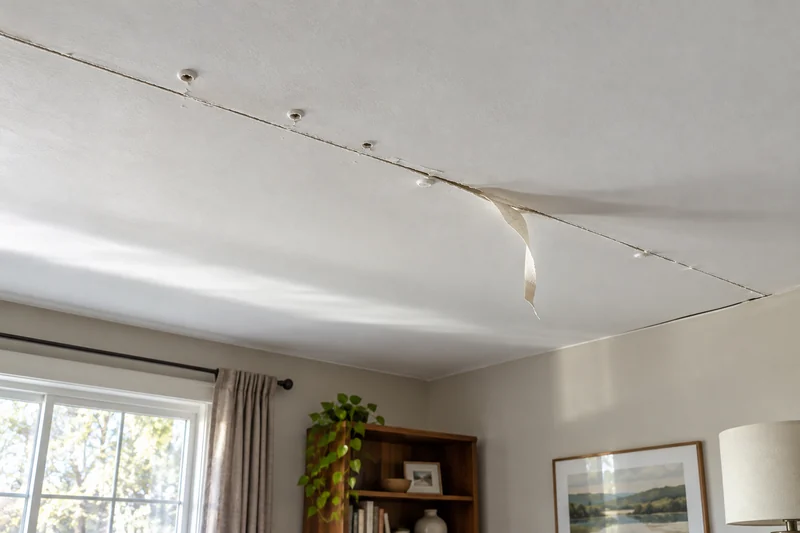
Where a crack sits and which way it runs are clues, never conclusions. We are a ceiling crack repair contractor and we do not diagnose foundation or structural movement for you. A hairline crack in the open field of a panel is a smaller, separate matter. Wider, recurring, or displaced cracks can warrant evaluation by another qualified professional, and we will say so when we see one.
Nail Pops and Fastener Movement
A nail pop appears as a small round bump or chipped dimple in the finish, and you usually see several in a line because the fasteners follow the framing member above. As the framing lumber dries and shrinks away from the board during its first years, or a fastener works loose, the head is left standing proud and pushes the compound off its face.
Simply filling the bump leaves the loose fastener in place, so ceiling nail pops come straight back through the new compound. Nail pop repair means removing the fastener or driving it home, setting a new screw into the framing beside it, and filling both heads below the surface.
Sagging and Bowed Panels
A sag is the panel bowing downward between the framing members that support it, and homeowners treat it as a cosmetic problem more often than any other failure here. It is not. The board is no longer being held flat, so filling the low spot does nothing to correct the reason it dropped.
Four things cause a panel to drop. The first is board that is too light for its span: half-inch board hung on framing spaced 24 inches apart is too light for that span and bows under its own weight over time. Water soaking in from above softens the board and adds weight. Damp blown-in insulation left resting on the back adds weight the panel was never hung to carry. Adhesive and fasteners can also release and let the panel drop.
From the floor, you can tell a bowed ceiling panel from an entire ceiling that is out of plane. A dip that runs between two framing lines and stops is one panel. A whole room that is drooping points to a different problem. Deciding what thickness goes back up and at what spacing belongs to ceiling installation rather than sagging ceiling repair.
Loose Sections and Ceilings That Have Let Go
A loose ceiling section has pulled away from the framing behind it, leaving its weight supported by whatever tape and fasteners are still holding. Those were never designed to carry an entire section on their own. Pushing the panel back up does not reattach it.
This is the one type of ceiling damage that makes the room itself a concern. Stop using the space beneath it and have the ceiling inspected.
Because this cannot wait, we offer same-day and next-day scheduling when openings are available.
Holes and Openings Left by Other Trades
A large share of ceiling openings are cut on purpose. Plumbers, electricians and HVAC technicians open a ceiling to reach a pipe, wire, duct or air handler, then leave the opening for a drywall crew to close at whatever size that trade needed to do the work.
These are usually the most straightforward ceiling hole repair jobs we handle because the cut edges are clean, the surrounding board is still dry and securely fastened, and there is no moisture to wait on before work begins. Ceiling patch repair closes the opening and carries the finish smoothly across it, while matching the existing texture is a separate part of the job.
The other kind comes from above. A foot or tool pushed through the board from the attic side leaves a ragged break with crumbled edges, and while it looks worse than a square hole, it is not a worse repair.
Free Quote FormRepairing a Ceiling Without Replacing It
A ceiling repair places new gypsum board into an opening cut from the ceiling you already have, and every decision starts with the board that remains. Gypsum board is the pressed mineral panel behind your ceiling paint, wrapped on both sides in heavy paper. Where that panel is still firm and securely fastened to the framing above, it can be cut cleanly, screwed into, and finished against.
Where the board has gone soft, it can no longer hold a fastener or provide a solid edge for new material, so the repair has to extend beyond it. That is why the damaged material determines the size of the opening rather than your preference or ours. It is also what drywall ceiling repair contractors are checking for when they press on a ceiling before quoting the work.
Finding the Edge of the Damage
The first step in any ceiling patch repair is finding where the damaged drywall ends and sound board begins, and we do that by hand. Sounding means pressing and tapping across the ceiling with a palm or knuckle, then listening and feeling for the change: firm board responds solidly, while board that has been wet gives under pressure or sounds hollow where it has let go of the framing. We mark that boundary and cut beyond it. Cutting the opening too small is the expensive version of this job, because weakened board at the edge of a patch is still weak after the patch is finished over it, and it fails along that same line a season later.
The opening is then squared so the new piece has straight edges to meet, and if a joist runs close by, we carry the cut to it. A joist is one of the framing timbers overhead that the ceiling is fastened to. Where no joist is close enough, we add backing instead, which the next part explains. The framing above must be dry before we close the ceiling. Drying a wet cavity and taking the meter readings that clear it are part of water damage work rather than this repair.
Opening a ceiling that has been wet is where established mold growth turns up, if it is anywhere. If we uncover established mold growth, we stop, document it, and refer you to a licensed mold professional before the rebuild continues. In Texas, mold assessment and remediation are licensed by the Texas Department of Licensing and Regulation, and that licensing is what the referral is for.
Backing, Fastening and Why Gravity Decides It
A wall patch is held in place, but a ceiling patch has to be held up, and nothing about a ceiling patch repair stays in position on its own. Backing is made from strips of material fixed behind the existing board and spanning the opening, giving the new piece something solid to screw into along edges where no joist runs.
Screws into framing are spaced about every 12 inches on a ceiling, closer than the roughly 16 inches used on a wall, because overhead fasteners carry weight continuously rather than simply resisting an impact. Each screw head is set just below the paper surface without breaking through it, since a head driven through the face paper grips torn fiber and holds nothing. Fit a piece with adhesive or a friction fit and no backing, and it will drop or crack around the edge once the compound dries and shrinks.
Taping the Repair Into the Surrounding Ceiling
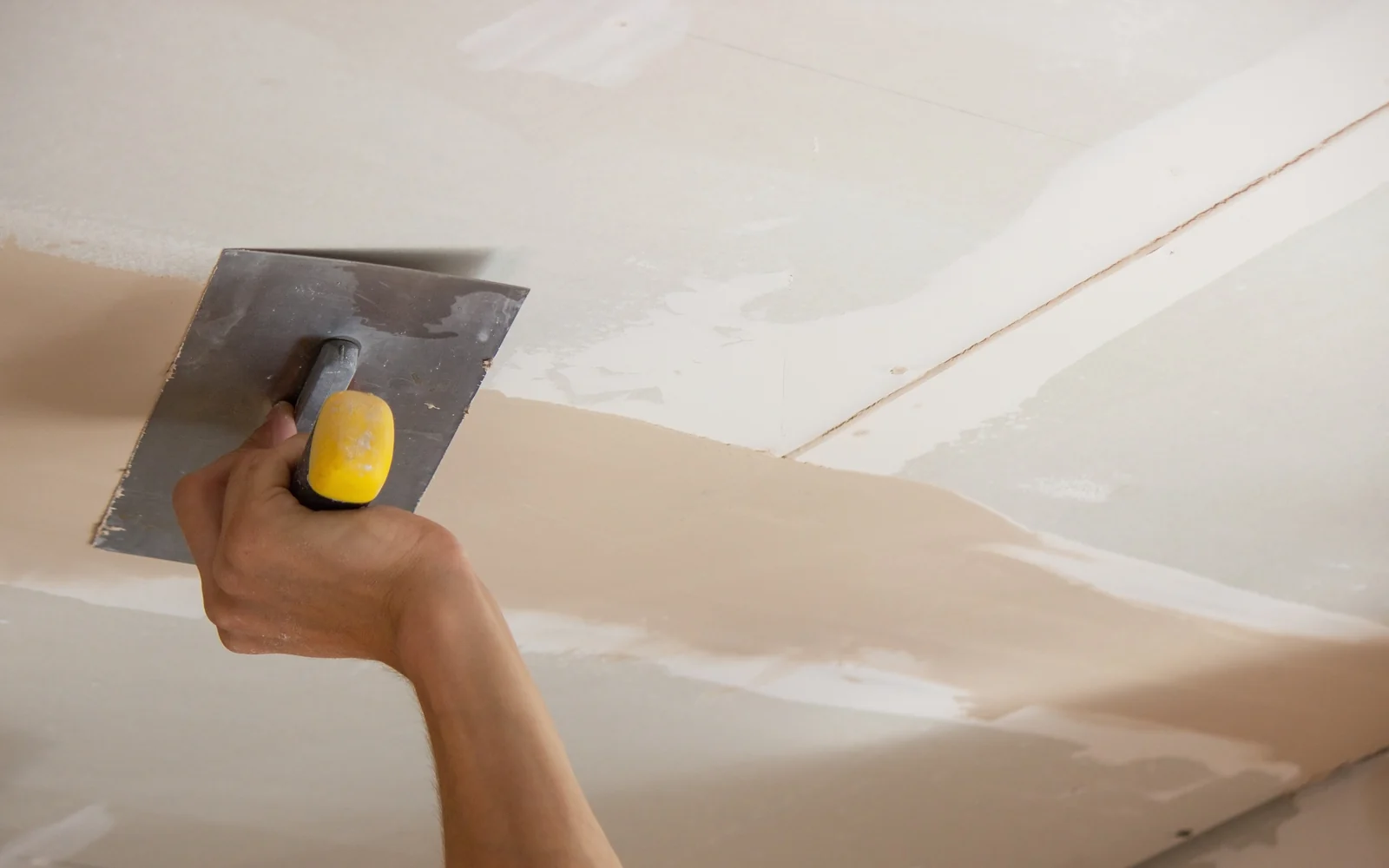
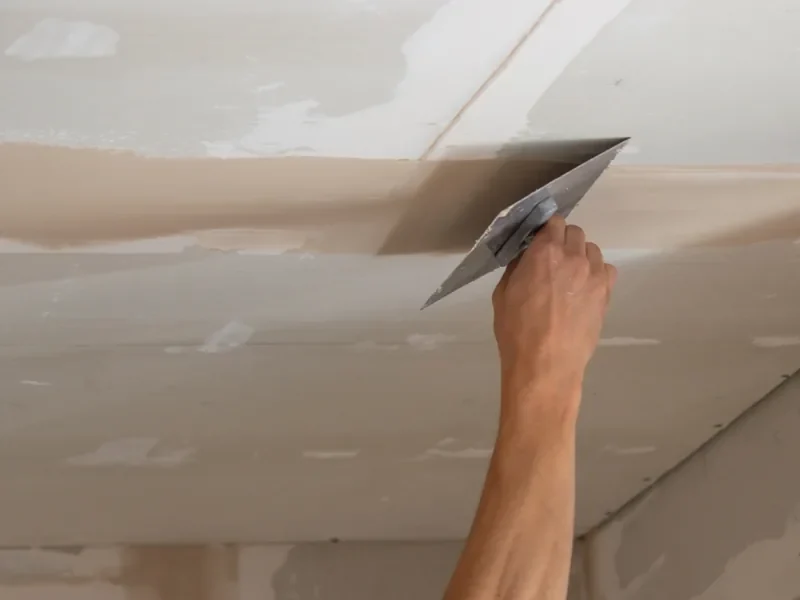
What gives away a poor drywall ceiling repair is almost never the patch itself but the joint around it, and a joint is made invisible by spreading it wider rather than building it thicker. Paper tape is bedded into wet joint compound over the seam so the joint stays stable once the compound sets. Feathering means thinning each coat outward so the edge blends into the surrounding ceiling instead of ending in a visible line.
A ceiling joint is feathered wider than a wall joint because light travels across the ceiling at a low angle, and a narrow, thick joint casts a shadow that appears from below as a ridge. Three coats is the usual number for a ceiling joint, with each coat spread wider than the one beneath it.
On a textured ceiling, the joint is finished to Level 4 and the texture is matched across it before flat paint goes on, because matched texture under a flat sheen is what keeps the joint from showing. A smooth ceiling gives the light nothing to break up, so the repair receives a skim coat carried well beyond the patch before it is primed. A seamless ceiling repair is a joint you cannot find, not simply a patch you cannot find.
Why a Stain Comes Back Through Fresh Paint
Water leaves dissolved material behind inside the board, and that deposit is what a ceiling stain actually is. Roll water-based paint over a water-damaged ceiling and the water in the paint re-wets the deposit, carrying it into the fresh film as the paint dries, which is why the stain returns within weeks. A stain-blocking primer seals the deposit in place instead of simply covering it, and the primers that do this are shellac-based or oil-based.
PVA primer is a different product for a different job: it seals fresh, unpainted board so the finish paint absorbs evenly, but it does not block a stain. Using PVA over a stain is the common mistake. We determine which primer your ceiling needs when we prepare the estimate. The repair and primer are included as standard, while finish painting remains optional on its own line. That line also states whether the paint covers only the patch or the entire ceiling, because fresh paint beside older paint can stand out just as clearly as a mismatched texture.
Matching the Texture Overhead
Most ceilings here have a textured finish rather than a smooth surface, and a textured ceiling repair is judged by how well the new area disappears into the existing finish. Knockdown creates flattened splatters with soft edges, orange peel leaves a fine spatter similar to the skin of the fruit, and hand textures are worked with a trowel or brush and vary from house to house.
Popcorn is the other common finish, sprayed on as a coarse mineral coating and found in many older houses here. Our texture matching starts by reading the existing ceiling and working to what is already there rather than choosing a product off a shelf. Producing a true match is a finishing skill in its own right, because a patch with the wrong texture shows as a flat spot the moment light rakes across the ceiling.
A popcorn ceiling is the exception because patching it disturbs the texture around the repair. On a ceiling installed before 1990, we test the material before any cutting or scraping begins. If the test comes back positive, a licensed abatement contractor handles that material before we return. Removing a popcorn ceiling entirely is a different job from patching one.
Why The Woodlands Drywall Co. for Ceiling Repair
Ceiling repair goes wrong most often when the surface is closed up while the cause of the damage is still active above it. We inspect above the board before closing the ceiling because a stain or shifted panel is the visible result of something happening overhead, and leaving that cause in place brings the same damage back in the same spot within a season or two. Finding the cause first is the step we will not skip, and it is worth asking any drywall ceiling repair contractors you call whether they do the same.
Texas does not license the drywall trade, so there is no state credential for you to look up on a ceiling repair contractor. What you can check is insurance, and The Woodlands Drywall Co. is fully insured. That is worth confirming before we set a ladder over your furniture and open a panel above it. The Woodlands Drywall Co. has served The Woodlands, Texas, for 20 years, in occupied homes and commercial interiors where people are working in the next room.
Three things happen before you make any commitment, and finding out each one costs you nothing.
- We come out at no charge to inspect the ceiling in the room where the damage is.
- You receive an itemized written quote, with any optional work listed on its own lines.
- Financing available for qualifying work.
You can call us at (346) 248-4075 to schedule that visit, or tell us about the ceiling through our quote form.
What a Ceiling Repair Costs
Ceiling repair is priced by the job rather than by the square foot because two ceilings with similar-looking damage can require very different amounts of work. We price new board installation by the square foot, but a repair is quoted as one price for the entire job, with a typical single-room ceiling repair ranging from $200 to $1,200. A small patch beside a light fixture sits at one end of that range, while rebuilding a section of ceiling sits at the other.
Photographs of the damage are usually enough for us to place your ceiling somewhere within that range, and that first price is often close. Several things can change the drywall repair cost once someone is standing beneath the ceiling, and each is difficult to judge accurately from a photograph:
- how many damaged areas there are and the size of each one
- overhead labor, which takes longer than the same work on a wall
- ceiling height and site access, including how the room is reached and what has to be moved or climbed
- texture match difficulty, meaning how closely the existing finish can be reproduced
- water damage that extends farther behind the finish than the visible mark suggests
Combining several repairs into one visit lowers your cost because the setup is paid for once instead of three times. Your itemized estimate separates the cost of the board, finishing and texture, so you can see exactly where the ceiling repair cost goes. Call us at (346) 248-4075 to have us take a look, or send the details through our quote form, and the firm price is based on what we see in the room.
Protecting the Room Below a Ceiling Repair
Ceiling work sends everything downward. Once a ceiling is opened, dust, broken pieces of old board and sanding grit fall onto whatever is beneath the repair, unlike wall work where most of the mess drops straight to the floor at your feet. That is why the room below is protected first, and the ceiling is not touched until it is.
Here are the five steps we follow on a ceiling repair, in the order they happen.
-
Inspection and Written Estimate
The Woodlands Drywall Co. sends someone to the house to stand under the ceiling with you, at no charge. Within 24 hours of that visit you have an itemized written quote in hand, with the repair itself priced on its own lines and any optional work listed apart from it, so you can accept one without accepting the other.
-
Clearing and Covering the Room
Before any tool comes out, we ask you to move small or valuable items out of the room, and we move the larger furniture clear or cover it. Floors go under drop cloths across the whole work area, and light fixtures and air vents under the repair are covered as well, since a vent left open pulls dust into the rest of the house. If you are living in the home while we work, we close the doorways and openings off with plastic sheeting, which is dust containment: the dust stays in the one room instead of settling through the others.
-
Opening the Ceiling
We cut the old board back past the damage until we reach material that is still sound, because new board fixed to weakened board fails in the same place again. Only with the ceiling open can anyone see how far the damage really went, and it is sometimes further than the estimate assumed. You hear about that from us standing in the room at that moment, not for the first time on an invoice.
-
Board, Tape and Coats
Backing and new board go up, then paper tape and joint compound over the joints. Each coat has to dry before the next one goes on, so a repair that needs several coats means we return on another day rather than force a coat onto a damp one beneath it. That waiting time is already counted in the schedule you were given.
-
Texture, Cleanup and the Walkthrough
We match the finish to the ceiling around it, and we capture the sanding dust at the tool rather than sweeping it back into your room. Our debris leaves with us. Then we walk the room with you for the final walkthrough and look at the ceiling from where you will see it every day, standing on the floor in the room's own light, and anything you point out is put right before your invoice goes out.
To start the drywall repair process, call (346) 248-4075 to book the first visit, and we will send someone out to the house.
What the Attic Above Your Ceiling Is Doing
The space above your ceiling is not air-conditioned. In our humid subtropical climate, where summer highs run near 94 degrees, that space stays hot for most of the year and carries a great deal of moisture with the heat. Blown insulation across the ceiling separates that attic air from the rooms you live in, but nothing separates the ceiling from what happens directly overhead. Any water that forms or collects in the attic lands on the top side of the ceiling board, soaks through it, and appears on the painted surface below. So if you are looking at a fresh mark and the roof has already been checked, the cause is usually still somewhere above you.
Condensation From the Ducts Above Your Ceiling
Warm, damp air releases moisture onto any cold surface it touches, which is why a glass of iced tea leaves a ring of water on a summer afternoon. The cooled ducts running through your attic and the air handler they come from sit in that same hot, humid air, so moisture collects on their cold surfaces. That water then drips onto the top side of the ceiling board and leaves a mark below.
A ceiling stain caused this way looks the same from the floor as one caused by rain coming through the roof, so a water-damaged ceiling can send someone onto the shingles for weeks searching for a leak that is not there. A blocked or disconnected condensate drain, the small line that carries away the water an air conditioner removes from the air, releases far more water in far less time. We repair the ceiling; a heating and cooling contractor handles the equipment above it.
Does Insurance Cover a Ceiling Repair?
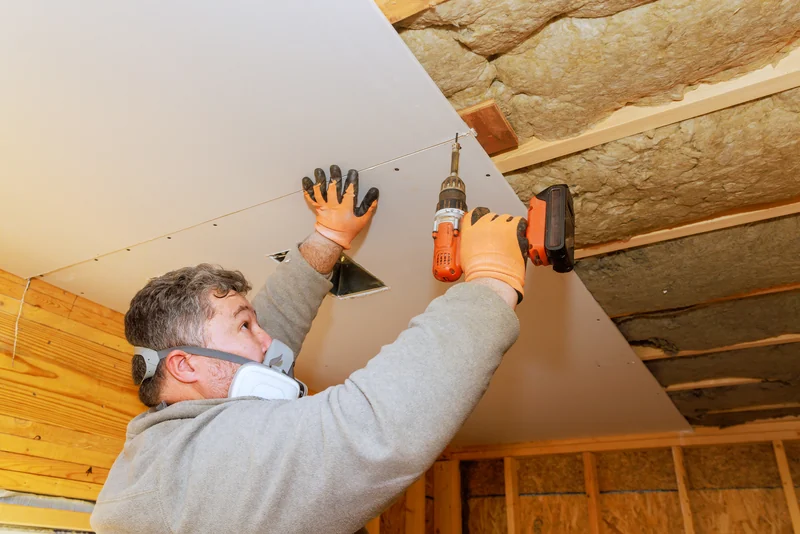
Insurance coverage depends on the policy you hold, not a decision we make for you. We can tell you what the damage is and what it will cost to put right, but whether any of that cost is reimbursed is settled between you and your insurer. The useful thing to know before you call is that insurers pay much more attention to how the damage happened than to the size of the bill.
Sudden Ceiling Damage and Damage That Built Up
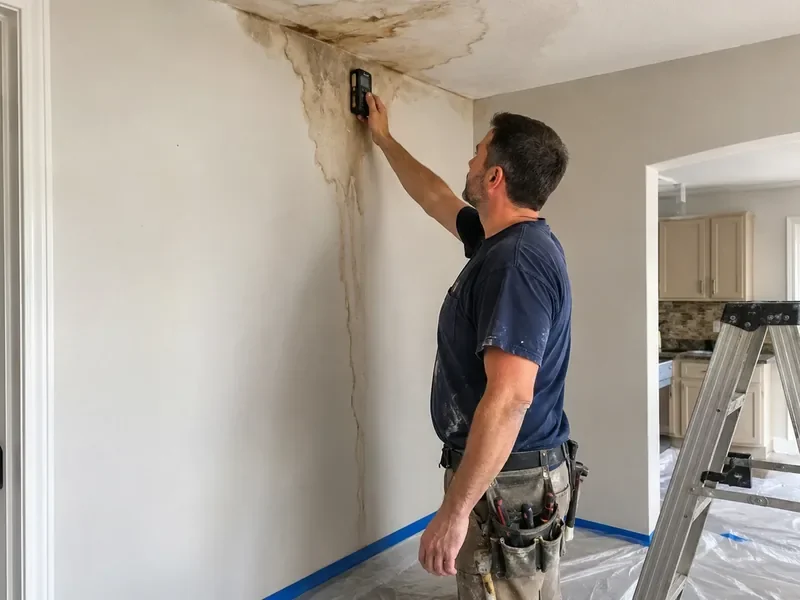
Homeowner policies generally separate damage that happens all at once from damage that develops slowly. A pipe that bursts above a bedroom or a storm that opens the roof falls into the first category, which is the kind a policy usually covers. A water-damaged ceiling that darkened over two winters beneath a slow drip falls into the second, along with ordinary wear and anything left unrepaired, and that is the type policies commonly exclude.
Your deductible, the amount you pay before insurance contributes, can be higher than the full cost of a small ceiling repair, so filing a claim is a decision you make rather than an automatic next step. Read your own policy or call your insurer; we do not interpret the policy for you.
What Gets Documented About Your Ceiling, and What Stays With You
We photograph the damaged area and provide an itemized cost breakdown, and both are yours to use however you choose with your insurer. We do not file your claim, manage it, negotiate it, or advise you on it, and nothing we provide should be understood as doing any of those things. Timing is the part to plan around: once we close the ceiling with new board and finish, an adjuster can no longer see what was behind it, so the damage needs to be documented while it is still open to view.
What to Expect Before You Commit to a Ceiling Repair
Once someone has inspected your ceiling, two questions usually come up together: whether repairing the existing ceiling is still the right choice, and how long the work will keep the room out of use. Neither is decided by a square-foot rule of thumb or a standard number of days. Both depend on what the ceiling is doing overhead, which is why we answer them after seeing the damage rather than before.
When a Ceiling Repair Turns Into a New Ceiling
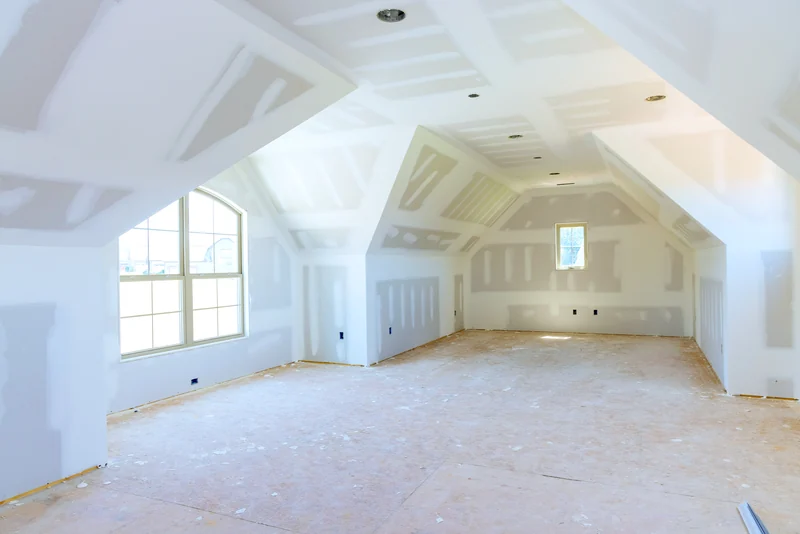
Repairing part of a ceiling stops making sense once the sound material around the damage runs out. A patch depends on securing new board to firm board and solid framing on every side. Damage that crosses several framing bays, the parallel gaps between the timbers overhead, has already spread beyond what that support allows. Board that has gone soft across a wide area gives a patch nothing solid to sit against, and a surface that no longer lies flat from one wall to the other is beyond what filling a single area can correct.
When the same spot fails repeatedly, the underlying cause has not been corrected, and when the finish is so worn or heavily patched that no texture match is possible, the entire surface remains mismatched. In those cases, you need new board across the room. That is a ceiling replacement, which we handle as ceiling drywall installation, a separate service. One condition overrides everything else: if water is still reaching the ceiling, any surface repair will fail again, so the water has to be stopped first.
How Long a Ceiling Repair Takes
Joint compound needs time to set before the next coat goes on, and adding more people to the job does nothing to shorten that wait. The drywall repair schedule follows the number of coats your ceiling needs rather than the size of the damaged area, so a small stain that has to be sealed before finishing can keep the job open longer than a large, clean opening.
Three things extend the schedule: an opening that has to be cut back farther than the visible damage first suggested, a texture built up in several passes, and a surface that must be sealed before any finish coat goes on. Drying time is what we plan around, and once we open the ceiling, we tell you which of those applies to your repair.

Ceiling Repair Across The Woodlands, Montgomery and Harris Counties
Southeast Texas sits in the path of hurricanes and tropical storms coming ashore, and the wind and rain they bring can open roofs above finished rooms. During storm season, water that gets through the roof runs into the attic and appears on the ceiling below as a brown or yellow mark, making it the most common reason we are called for ceiling repair from summer through late fall.
The rest of the year, the weather works more slowly. Our humid subtropical climate keeps the air warm and heavy through most of the calendar, with summer highs near 94 degrees, and that moisture fills the attic above your ceiling, leaving framing and insulation damp long after the last storm has passed. Damp attics create their own marks on the ceiling below without any rain coming through the roof. Both patterns are common across Montgomery County and into neighboring parts of Harris County.
The Woodlands Drywall Co. provides ceiling repair in twenty-one communities across this part of Texas:
Where The Woodlands Drywall Co. Repairs Ceilings
Villages of The Woodlands:
- Alden Bridge
- Cochran’s Crossing
- College Park
- Creekside Park
- Grogan’s Mill
- Indian Springs
- Panther Creek
- Sterling Ridge
And the surrounding communities:
- Conroe
- Atascocita
- Spring
- Porter
- New Caney
- Humble
- Kingwood
- Tomball
- Willis
- Pinehurst
- Shenandoah
- Oak Ridge North
- Magnolia
Ceiling Repair Questions
How much does a ceiling repair cost?
Most ceiling repairs fall between $200 and $1,200. Two things determine where a job lands within that range: how much of the ceiling is damaged and how difficult the existing finish is to match. A plain flat ceiling takes less work to blend than one with a sprayed texture, and you get the price for your own ceiling at the estimate.
Can I repair a ceiling myself?
A small hole in sound, dry board on a flat ceiling is a reasonable repair for a careful homeowner. Two things derail most attempts: the joint compound needs to be feathered a foot or more beyond the patch rather than just a few inches, and matching texture is a skill rather than a product you can simply buy. If the board is soft, sagging or stained, the surface is not the real problem, and filling it will not hold.
Should I repair or replace my ceiling?
Press the board beside the damage from a stepladder. If it stays firm and still holds a fastener, repair is the cheaper and less disruptive option, and whether to repair or replace your ceiling is decided by the condition of that board, not by how big the mark looks. Replacing an entire ceiling does not fix whatever damaged the first one, so new board installed beneath an unresolved cause will fail the same way the old board did. Full replacement is installation work rather than repair.
Does insurance cover ceiling repairs?
Policies depend on how the damage happened rather than how the ceiling looks now. Either way, there is one practical step to take first: you cannot compare a claim with your deductible until you know the repair cost, so get the free estimate before deciding. We provide photographs and a written cost breakdown, and we do not file, manage or negotiate a claim.
Do you repair water-damaged ceilings?
Yes, once the work happens in the right order. Whoever is responsible for the leak stops it first, the cavity then has to read dry, and the rebuild comes after that. Expect the opening to be larger than the visible mark on your ceiling, because water spreads well beyond the point where it discolors the paint. The drying itself is water damage work.
What types of ceiling damage can you repair?
We repair stains, cracked seams, nail pops, sagging and bowed panels, loose sections, holes, and access openings left by other trades. In every case, the deciding factor is whether the board around the damage is still sound and dry.
Will the ceiling repair be visible after completion?
We work toward a repair that disappears into the ceiling, and two conditions make that more difficult. Strong side light from a window or fixture is the toughest case, while an older finish that has already been patched several times leaves multiple patterns to blend into instead of one. Before any invoice is written, you stand beneath the finished repair and inspect it with us.
What does it cost to replace a 12x12 ceiling?
A 12 by 12 ceiling is about 144 square feet. Replacing a ceiling is priced by the square foot, just like installation, rather than by the job like a repair, and that is the distinction most people are missing when they ask. Full replacement is installation work, and the price for your room comes from the estimate.
Get Your Ceiling Assessed by The Woodlands Drywall Co.
A stain, crack or dip overhead does not settle down once it appears, and the mark you see today is usually a little larger by next season. Seeing the ceiling in person costs you nothing, and it is what turns an estimate into a firm price for ceiling repair anywhere in The Woodlands. Reach The Woodlands Drywall Co. at (346) 248-4075, or tell us about the room through the quote form, and we will inspect it at no charge and put a written price in your hands.